You know, I was all for this whole Iraq War thing… but, goshdarn it, Madonna’s opinion pushed me over the edge. No Blood For Oil! But, you know, they make the plastic in CDs from oil… Help me, I’m confused! (þ: memeorandum)
![[Signifying Nothing]](/local/memlogo-1.png "Welcome to Signifying Nothing")
Wednesday, 10 November 2004
![[Permalink]](/images/permalink.png "Permanent link to this entry")
Amusing Google Search of the Day
Apparently I’m easily amused:
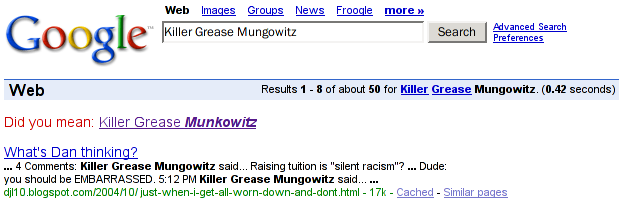
The search for “Killer Grease Munkowitz” turns up nothing. Or at least did before this post was indexed by Google.
Groupthink
Mungowitz End points in the direction of an interesting Chronicle of Higher Education op-ed by Mark Bauerlein, an English prof at Emory, arguing that left-wing dominance in the academy is detrimental to intellectual discourse.
I tend to think that it’s important in the classroom to ensure that everyone’s ideas or preconceptions are challenged; ironically, I think this makes me look like a flaming liberal in front of my (quite conservative, with a few exceptions) Intro class and something of a greedy capitalist bastard in front of my (bleeding-heart liberal) Con Law class—of course, Methods makes me look like a sadistic bastard who likes to torture students with math, but that’s to be expected, and rather non-ideological (at least outside of The Discipline) to boot. So be it.
Tuesday, 9 November 2004
Ashcroft-free justice
I can’t say I’m particularly disappointed to see John Ashcroft getting shown the door at DoJ, although his caricature as the bogeyman of America’s civil liberties has been just a tad exaggerated over the years.
Monday, 8 November 2004
Yassir "Dave" Arafat
Free hint to the Palestinians: you’re supposed to hire the actor to pretend to be the guy before he falls into the irreversible coma.
Zinging Zellweger
It’s apparently Renee Zellweger day on the blogroll; Sheila O’Malley wonders why Ms. Zellweger has a career, while Alex Knapp thinks she* looks better with a few extra pounds on her frame.
This half of Signifying Nothing is agnostic on both questions.
It's the consumers, stupid
Tyler Cowen wonders why health care sucks:
It remains a mystery, why private health insurance has performed badly in holding down costs. Companies compete fiercely to shed costly patients but they do less to invest in reputations for reliability and trustworthiness. Similarly, it is a puzzle why HMOs don’t do more to invest in good reputations; lately Kaiser has moved in this direction.
All of this, I suspect, can be traced directly to the disconnect between health care consumption and health care customers; employers contract with health care plans as a fringe benefit for their employees (which Cowen has noted before), but they have no real incentive to make sure the health insurance is good (although there certainly is an incentive to make its cost as low as possible), except to the extent that a good health insurance plan can attract new employees; but, once employed, few people change jobs solely because their health insurance sucks (and nobody in a cartelized labor market, like academe, does so), so there’s little incentive to improve health care coverage.
It seems to me the sensible course forward is to couple HSAs with incentives for employers to provide a health insurance purchasing account (in lieu of employer contributions), which employees could use to purchase a health insurance plan in a competitive market. This would align the customer-consumer interest much better than the present system.
Fictitious elections
Reason’s Tim Cavanaugh helpfully rounds up all the vote fraud allegations in one place, while Slashdot’s CmdrTaco continues to parody DemocraticUnderground. (Oh, you mean he’s serious? Never mind.)
I’ll just join the bandwagon by complaining that I had to stand in line for 30 minutes in a fire station that was open to the elements at both ends to cast my votes, zero of which turned out to be pivotal. I blame Diebold; they had nothing to do with the electronic voting machines in Hinds County, but I think they’re vicariously to blame somehow anyway.
Sunday, 7 November 2004
Alabama's blue belt
Looking at the red/blue county map, it’s pretty easy to correlate most of the blue counties with major urban population centers.
One thing that has me mystified, though, is the neat blue line bisecting otherwise red Alabama horizontally, seemingly following the path of Highway 80, as far as I can tell, and bleeding over slightly into Mississippi and Georgia on either side. Montgomery, Alabama’s capital and second largest city, is in the middle of the blue strip, but what about the rest of it? What’s the explanation of Alabama’s “blue belt”?
Update: Chris explains in comments that Alabama's "blue belt" is Alabama's black belt.
Borking Specter
Hugh Hewitt thinks the Bainbridge-Corner campaign to push Arlen Specter out of the judiciary chairmanship is a really bad idea. Perhaps if they won’t listen to me or Hei Lun of BTD, maybe they’ll listen to him (þ: Glenn Reynolds).
Update: Ok, so much for that idea. These guys at NRO really don’t get it, do they? Meanwhile, James Dobson has joined the pile-on (þ: How Appealing), while Michael Totten is unimpressed to say the least.
Creationism comes to Wisconsin
I tend to agree with James Joyner and John Cole that putting creationism in the public school curriculum on-par with evolution is a thoroughly dopey idea.
That said, Jim Lindgren points out that the textbook on evolution in question at the Scopes trial was a load of racist, eugenicist trash—the sort of stuff that’s fortunately marginalized (though perhaps not marginalized enough in Hart’s case) in today’s society.
Online book on Gödel's theorems
Prof. Peter Smith of Cambridge University has posted sixteen chapters of his work-in-progress on Gödel’s incompleteness theorems and related mathematical/logical/philosophical goodness in PDF format, beautifully typeset using LaTeX.
I’ve read the first twelve chapters, which take you through Gödel’s first and second incompleteness theorems, Tarski’s theorem on the undefinability of truth, and (the most surprising result, IMO), Löb’s theorem.
You’ll need a background in symbolic logic to understand it. If you don’t know your ∀s from your ∃s, you’ll be lost.
Smith takes the opposite approach from Boolos and Jeffrey, taking you through Gödel’s theorems using only the apparatus of primative recursion, saving full-blown recursive function theory and other topics in computability theory for later.
It’s been a while (about seven years) since I’ve been through the material, but I learned a lot of stuff I didn’t pick up the first time around.
(þ Brian Weatherson.)
Post-election irony watch
Matt Welch notes the irony of a wine-sipping, BMW driving, California law professor lecturing liberals on “elitism”.
Prof. Bainbridge responds to Welch with “I know you are, but what am I?”
Racist gets 59,602 votes
Racist and eugenics advocate James Hart garnered 59,602 votes in Tennessee’s 8th Congressional district, 25.8% of the total vote. (Final results for all Tennessee U.S. House elections.)
Of course, I know that only means that nobody pays attention to Congressional races in uncompetitive, gerrymandered districts, and almost everyone who voted for him did so only because he was in the Republican column on the ballot.
Still, it’s pretty sad.
Prohibition in Chicago
Jim Leitzel at ViceSquad points out an unusual intersection between liquor laws and ballot referendums in Chicago. In Chicago, individual precincts can vote themselves dry in referendums, or even vote to outlaw sales of liquor at a specific address in the precinct.
Here are some examples from this year’s ballot. Ward 11, precinct 35, voted, 178 to 88, to forbid the sale of liquor at 4220 South Halsted Street.
Was there a surge of evangelical voters?
Alex Knapp says there was not:
I think it’s important to point out that there was no surge of evangelical voters for Bush that made the difference in the election. It simply wasn’t there. The gains Bush saw came as a result of terrorism. That’s what the numbers say.Dorian Warren says there was:
Maybe I'm missing something, but based on my read of the exit polls, the religious right had a significant impact on this election. White evangelicals were 23% of the electorate, an increase of +9 points from 2000! They broke 78% Bush, 21% Kerry. Is a 9 point increase insignificant?Update: Philip Klinkner thinks the 9 point difference between 2000 and 2004 is due to a difference in wording. Damn, if they're not going to ask the same questions from year to year, how can one expect to track the trends?
Saturday, 6 November 2004
Majors beat Rhodes
Bad news for my co-blogger as my employer’s football team beats his alma mater’s, 28–19. Congratulations to the Millsaps Majors (4–4, 3–2) on getting back to .500 after two consecutive road wins, heading into next Saturday’s final game against #6 Trinity (8–1, 5–0).
Friday, 5 November 2004
Why statistics are helpful
Philip Klinkner manages to present in a four-line table what takes Andrew Sullivan’s anonymized correspondent a paragraph and a bunch of raw numbers.
Both, incidentally, show that the anti-same-sex marriage initiatives had no effect on Bush’s share of the vote in the states where they were on the ballot.
Exit polls misjudged?
Contrary to popular wisdom, Andrea Moro says the final exit polls were accurate and has the numbers to prove it. However, that doesn’t quite explain how the networks nearly blew the calls based on the Kerry-leaning numbers they had—and, once you have the final results, it’s easy enough to go back and reweigh the data to match the “true” results; I’d be curious if anyone has hardcopy of the exit poll results, including the weights, dating from before the returns came in.
A majority, if you can keep it
Apparently Tuesday’s whopping 3% landslide win for George Bush has gone straight to Stephen Bainbridge’s head. Not content just to insult libertarians, he’s decided to make Arlen Specter his personal whipping boy, apparently under the delusion that Specter would take being deprived of his (rightful, under Senate seniority traditions) chairmanship of the judiciary committee any way other than defecting to the Democrats, and probably taking the majority with him—Lincoln Chafee has already made noises about leaving the GOP caucus, and shunting Specter aside would be the handwriting on the wall for folks like Judd Gregg, Susan Collins, Olympia Snowe, and John McCain that the “big tent” is shrinking. If you think Judiciary is hard to get conservative judges through now, just wait until Pat Leahy or Ted Kennedy is running the show.
Joe Gandelman has more realistic thoughts on what’s likely to happen, while the quotes in Friday’s New York Times suggest Specter is unlikely to be pushed aside.
Update: Todd Zywicki apparently also doesn’t get that Specter won’t be the only Republican to defect if he doesn’t get the chairmanship. And citing a vote against Bork—given Bork’s increasing Gore-esque nuttiness over the past few years—doesn’t quite make a particuarly convincing case that a Democrat-led Senate is worth standing on some bogus principle of undying party loyalty.
Thursday, 4 November 2004
Dumpster diving
Oliver Willis digs up some lovely comments from Freepers regarding Elizabeth Edwards' breast cancer diagnosis.
Wednesday, 3 November 2004
Fumble and recovery
Russell Fox has a lengthy post on the meaning of the election for Democrats and their uneasy relationship with religion, which starts off rather poorly—anyone who writes ”[t]he great egalitarian accomplishments of the last fifty years… are all on the chopping block” is at the very least engaging in hyperbole—but makes some important points about “red state” voters (regardless of how I hate that term and the false dichotomy underlying it) that Democrats have lost their ability to reach out to.
I think, for what it’s worth, that John Edwards (or possibly Dick Gephardt) could have reached out to a lot of poor and middle-class white southern voters, but the one-two elitist punch of John and Teresa Heinz Kerry undermined any realistic chance of that happening. More to the point, one has to wonder about a national Democratic Party that can’t even secure the paltry share of the white vote in a state like Mississippi it would need to be competitive, but it’s unlikely to see an improvement until the party gets over its Dean-esque arrogance that Southerners need to stop voting on “guns, God, and gays” and come to the conclusion that they need to respect (even if it’s only to the point of respectful disagreement) those Americans who care deeply about those things.
Words to live by
Michael Munger argues that Duke’s Phillip Kurian is the poster child for some deeper problems in the academy:
More and more, faculty on the left just want students to have the “correct” conclusions, like a memorized catechism, instead of making sure the students can defend those conclusions in a debate. And students on the left are the ones who pay the price.
Mind you, I just spent a far larger proportion of my teaching day than I wanted on my soapbox, so perhaps I’m part of the problem, even though I make a very poor leftist.
Poll'd
I think the biggest news out of yesterday’s presidential election, at least for scholars of voting behavior, was the third consecutive meltdown by the national opinion polling service (previously Voter News Service, now Edison/Mitofsky).
What went wrong? Megan McArdle ponders, while the Mystery Pollster explains the process. My gut feeling is that the system in part failed because the networks replaced VNS; Edison/Mitofsky was new at this, and a rookie effort is fraught with perils—as I learned myself yesterday. Coupled, perhaps, with a small cognitive bias on the part of the people being paid by Edison/Mitofsky to conduct the poll themselves (one suspects the typical person looking for day-work isn’t a Republican) and you can easily see why they were quite a bit off, notwithstanding the advertised margin of error.

 Recent posts
![[The GIMP]](/buttons/gimp.png "The GIMP")
![[Steal These Buttons!]](/buttons/steal.png "Steal These Buttons!")


