Friday, 23 January 2004

DVDs and CSS

Will Baude has been inquiring about the DVD industry’s Content Scrambling System (CSS) and its associated region (or locale) coding system. Today he asks:

The question that then plagued me was why DVD-players went along with this system. It makes sense that DVD makers would like the ability to price discriminate in different markets, but wouldn’t Dell disk drives be worth more if they could play discs from all regions? Who gains from the limited switching?

DVD player manufacturers have to license the patents of the DVD Copy Control Association (as well as patents for other systems, like the Macrovision video copy protection scheme) in order for their players to legally play DVDs. The DVDCCA’s licensing provisions require manufacturers to implement the region locking scheme—thus, you can’t get a license to produce a DVD player if you don’t implement the scheme.

Now, some far-east manufacturers evade this requirement by conveniently “forgetting” to lock the DVD region settings of their players, or by leaving secret menus available to allow people to break the DVD region coding scheme. And, it is my understanding that unlicensed players based on the “DeCSS” code circumvent this region lock scheme completely, but I don’t own any DVDs from outside region 1 (USA/Canada), so I’ve never tested this for myself.*

Arguably, the whole system is illegal under WTO rules, which specifically prohibit schemes like region locking and rules against “reverse imports” that are designed to maintain regional price differentials. But given DVD manufacturers’ interests in maximizing their profits (particularly in often egregiously overpriced Region 2 markets like Great Britain) don’t expect this to change anytime soon.

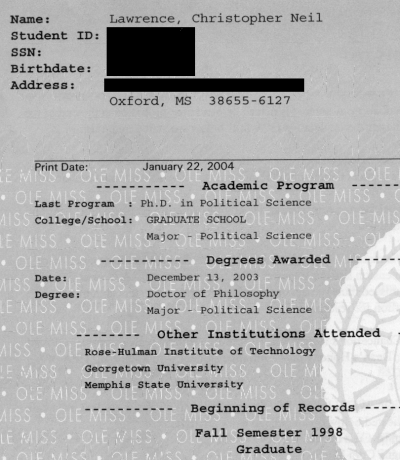
More transcript follies

IMHO, $4/copy is a blatant ripoff for an official transcript, particularly when they’ll give you unofficial ones for 25¢ per page.

But at least I now have some proof I actually accomplished something the last five-and-a-half years:

Double-teaming Clayton Cramer

I don’t exactly want to turn this blog into CramerWatch, but this post struck me as being, well, a tad odd. He quotes at length from a Reuters piece on penis enlargement spam (no, really) and comes across this lovely tidbit:

At the heart of the problem, [NYU psychiatrist Virginia] Sadock said, is that since men don’t see many penises other than their own, they have little basis for comparison.

The exception, she said, is pornography, which gay men view more that straight men. And comparing one’s penis size to a porn star’s could lead even a well-endowed man to feel inadequate.

So perhaps it’s not surprising that New York’s gay community self-help arena has expanded beyond problems such as alcoholism and over eating to the affliction of a small penis.

“What is Small, Anyway,” is the working name of a support group in Greenwich Village, which acts as a safe haven for gay men who have small penises, or feel as though they do.

Participants complain about a gay community in which men brag about being bigger than they are and a country where big is king. Like at other support groups, most in this group are grateful just to be in a room together with people trying to confront the same problem.

A slim man with reddish hair told a recent meeting that he is made to feel he doesn’t measure up. “In our community the idea of what’s average (size) is very distorted,” he said.

Cramer’s response: “Of course, this wouldn’t be the only area in which the gay community is a bit distorted about what it considers important.”

Now, this strikes me as something of a weird reaction. For one thing, you’d expect gay men to have a more realistic idea about penis size—not less—since they, er, see more of them than straight men do. For another, I’m not entirely sure that gay men watch more porn than straight men do; now, it’s possible that more gay men watch porn than straight men, and it’s likely that the porn gay men prefer (which, of course, would be “gay porn”) has more penises in it, but I’m not convinced that once you pass the “selection function” (to borrow from Nobel laureate economist James Heckman, who I’m sure would love to know his name is in this conversation) that the count is markedly different in the universe of “porn viewers.”

Lastly, anyone who’s seen the god-awful ads for “Enzyte”—a product for “natural male enhancement” (i.e. a penis enlargement pill, distinct from e.g. Viagra and Levitra, which are erectile dysfunction pills)—would know that it’s being aggresively marketed to heterosexual males. Show me a straight guy and I’ll show you a straight guy who’s obsessed with the size of his penis. What I can’t fathom is that Cramer is apparently more obsessed with gay men than the size of his.

The job trail

Cool thing discovered recently: the Chronicle has RSS feeds of its job listings.

Not-so-cool thing discovered recently: the postal service needs a 46¢ stamp. I went through two books of 23¢ stamps in about ten minutes on Wednesday. So much for saving trips to the post office…

Wednesday, 21 January 2004

Slumming in the blogosphere

Visiting today some regions of blogspace I usually avoid, I found one of Clayton Cramer’s observations about racism:

In general, racism of any sort tends to be strongest among people that are at the bottom of the economic ladder—and need someone below them to look down upon. If you can’t take pride in anything that you have accomplished, you can at least take pride in your race!
I wonder how Clayton would explain vile anti-gay bigotry.

The Arar Saga Deepens

Obsidian Winger Katherine R has been all over the Maher Arar case for the past couple of weeks; today she notes Juliet O’Neill’s reporting on the case, which has landed Ms. O’Neill under investigation by Canadian authorities. This report reinforces my previous suspicion that the whole situation was orchestrated from Ottawa, with U.S. authorities playing an important role of being all-too-willing to go along in making the dirty work happen. It’s clear Ottawa couldn’t have deported Arar to Syria themselves without there being domestic hell to pay—so they got us to do it for them.

Bottom line: I’m with Katherine on this: there need to be investigations on both sides of the border.

What's a fiscal conservative to do?

Juan Non-Volokh complains that fiscal conservatives have nowhere to turn:

Last night’s State of the Union included the usual laundry list of costly new proposals, further cementing President Bush’s record as a profligate spender. Even with increased economic growth, pursuing these initiatives will further delay deficit reduction. Alas, fiscal conservatives don’t have anywhere else to turn, according to this study by the National Taxpayers Union Foundation. To the contrary, based on their campaign platforms, NTUF found that every one of the contenders for the Democratic nomination would increase spending even more than it has grown under President Bush.

But the question should not be “what Bush will spend” vs. “what Democratic candidate D says he will spend“. The question should be “what Bush will spend” vs. “what Democratic candidate D will spend“. Any Democrat in the White House would have a powerful brake on his profligate spending plans that President Bush does not, viz. a Republican Congress. Andrew Sullivan has realized this, even if he can’t bring himself to support any of the Democratic candidates because of such important matters as endorsements by obnoxious jerks.

Of course, the worst federal spending (being not just wasteful but downright counter-productive), viz. farm subsidies, aren’t going anywhere anytime soon. But aside from farm subsidies, a Democratic president would have a hard time finding enough common ground with a Republican Congress to pass any major new spending initiatives. And with the House gerrymandered into Repblican hands for the forseeable future, there’s not much danger of a Democratic Congress coming around and allowing a Democratic president to have his way with the Treasury.

In SOTU operation

I didn’t watch much of the State of the Union Address (still working on syllabi, natch), but I did catch the tail end of it, and I sort of half-watched Chris Matthews anchoring MSNBC’s “postgame report”—the most interesting bit of which was the Frank Luntz focus group, I thought, mainly because I think those dial things they use are cool. Yes, I’m weird.

A few random thoughts:

  • Do the dipshits who applauded when they heard the PATRIOT Act is expiring realize that they almost all voted for the bloody thing? That was probably the most lopsided vote since they passed the hideous, not to mention blatantly unconstitutional, Communications Decency Act in the mid-90s. (Incidentally, blatantly unconstitutional laws appear to have this interesting habit of getting lopsided votes in Congress; someone should research this scientifically.)
  • I like the $300m for post-prison rehabilitation programs. Of course, I’d rather we decriminalize drugs and save ourselves the money, but that’s just me.
  • I suspect the gay marriage thing was actually aimed at SCOTUS, or more specifically, Sandra Day O’Connor. Guess we’ll see if she was listening.
  • At least Bush didn’t let out that Dean “crow sqwak” noise at the end of his speech.
  • Speaking of Dean, I’m shocked he failed to include Mississippi in the list of states he promised to win (Olbermann had a map thingy of the list tonight, which was entertaining). Must not be any of them voters with Rebel flags on the back of their F-150s down here…

Anyway, cover letters to write then bedtime. Toodles!

By the way, James Joyner of OTB has all the reactions linked to one convenient post.

Them's fightin' words

Patrick Carver is a wee bit upset by the one-sided nature of USM’s upcoming speaker series. I think he called Andrew Sullivan a “liberal” somewhere in there, too, but I won’t swear to it.

Fun fun fun 'till Mozilla took the T-bird away

My transition to living with Mozilla Thunderbird as my email client is complete, now that I’ve discovered the bliss that Seth, er, I mean, is the Debian packaging of enigmail (and, for that matter, T-bird; for some reason, I didn’t think it was packaged until I started fooling around today). The anti-spam features are easier than futzing with Bogospam, the IMAP support with the dovecot server seems pretty robust, and it seems reasonably fast for my purposes.

Tuesday, 20 January 2004

Fun with syllabi

I’ve spent most of today writing syllabi for courses that I’ve never taught, and probably will never teach (most notoriously, a syllabus for southern politics—a great class, and one that I’d love to teach, but one that nobody will offer north of the Mason-Dixon line). And I’m not done yet… still got a few more to go.

How this exercise proves I could teach these classes is beyond me. Gotta love being on the job market…

Dollar-Powered Howard

The news out of Iowa can’t be good for Howard Dean. The pressure’s now on for a convincing Dean resurgence in New Hampshire, which will be hard, given both Wesley Clark’s full-time campaigning in the state and John Kerry’s surge in Iowa.

Why did Dean sputter in Iowa? The easiest conclusion to draw is that Dean’s attempt to tap a well of anger among Democrats has failed, at least in Iowa, because Democrats as a whole aren’t quite that angry. According to the New York Times‘ account, Dean was unable to capitalize on anti-war sentiment:

A survey of voters entering the caucus sites Monday suggested that what had been Dr. Dean’s central appeal — his opposition to the war in Iraq — did him little good on Monday night. Just 14 percent said the war in Iraq had shaped their final decision, even though 75 percent said they opposed the war.

Dr. Dean’s showing also raised questions about what had been one of the most intriguing elements of the Dean candidacy: that he had recruited thousands of first-time voters who could transform the nature of American presidential politics. Although half the voters on Monday were attending their first Iowa caucuses, 36 percent voted for Mr. Kerry, compared with 22 percent for Dr. Dean and 24 percent for Mr. Edwards.

The question is now: what about New Hampshire? Clearly, Clark, Dean and Kerry are poised for a fight, with John Edwards in much the position he was in Iowa—any finish above fourth place can be spun as a win, as the key state for his fortunes is South Carolina—a state in which Dean has no traction and where, as Columbia’s The State reports, Kerry now has to scramble to rebuild an organization he dismantled to focus on Iowa and New Hampshire.

Of course, every reporter and political wonk’s fantasy is a brokered convention—something that isn’t in the cards quite yet, given that not a single delegate has been allocated so far. But, nonetheless, Vincent Kennedy McDean might be well-advised to tone it down a notch or two—while politics, like pro wrestling, is a rough-and-tumble sport, in only the latter do the “heels” often win.

Monday, 19 January 2004

The Man

Radley Balko shows the faces of the people who will, in all likelihood, decide the Democratic nomination. Here’s a hint: they look like Howard Dean’s cabinet in Vermont did…

Tricky Dick Deux

Kevin Drum reckons the soft underbelly of the Bush presidency is Dick Cheney:

I’m going to stick with my suggestion that the Democrats could gain some traction by making Cheney a bigger issue in the campaign than vice presidents usually are. It would require a subtle touch, of course, but let’s face it: nobody likes an evil genius operating out of a hole. There ought to be something there we can take advantage of.

On the other hand, Unlearned Hand isn’t buying quite yet:

First of all, I think most Americans just won’t believe any claims that the Vice-President is exerting so much control. It goes against all conventional wisdom on vice-presidencies, and that’s a lot of inertia to overcome.

I’m not so sure about that; vice presidents have become more salient figures over the past 10–15 years than they used to be (see, e.g., Al Gore), although I’ll agree that the size of Cheney’s role is unprecedented. I’m rather inclined to think that vice presidents ought to have larger roles anyway, within the limitation that their primary job is to not die before the president does.

Cheney’s large role, in a lot of ways, is probably due to the relative inexperience of Bush in national politics. Interestingly, though, the “Ex-Governor – D.C. Insider” pattern has applied to every presidential ticket since Ford’s.

Second, it can easily be spun (perhaps correctly) into proof that Democrats know they can’t win by going after the President himself. Karl Rove could have a field day running ads that say “They are picking on the President’s staff because they don’t want to go head-to-head with George W. Bush.”

Well, it’s one thing to go after Andy Card and another to go after Cheney—the latter’s name, at least, is on the ballot. And I think there are legitimate issues that can be aired about Cheney’s role vis à vis Halliburton. I don’t know that I buy them necessarily (Cheney is hardly the first beltway insider to “descend from heaven” into a cushy job in the private sector, to borrow the Japanese coinage), but it’s a legitimate topic for discussion.

Third, I think Cheney’s presence is actually reassuring to a lot of people. To the extent that people do buy into the “Bush is dumb” rhetoric, many of them think having Cheney around makes for a perfect complement: Bush gives them the leadership and machismo that reassures a frightened nation, Cheney provides the organization and runs a lot of the policy analysis.

Perhaps that’s the case. On the other hand, I think the public perception of Cheney is that he’s on the verge of death—hardly a reassuring image. On balance, I tend to agree with Kevin and think Cheney’s a liability, at least on the image side.

Personally, though, I think Democrats could make much more hay with the Creepy Combo of John Ashcroft and Tom Ridge—at least with libertarian-minded voters like me who are deeply skeptical about Homeland Security’s smoke-and-mirrors operation and Ashcroft’s ties to the fundies and the CCC types. With a reasonably credible candidate at the front of the ticket (at this point, it’d have to be Edwards or possibly Kerry), that sort of message might sway my vote.

This is today’s OTB Traffic Jam entry.

Crime and punishment

You’ll be hard-pressed to find it in Daniel Davies’ account, but the case of Katharine Gun, a former British intelligence officer who has become something of the “Valerie Plame” of the anti-war movement on the other side of the pond, seems rather open-and-shut.

Gun, an admitted opponent of the war in Iraq, is charged with violating the Official Secrets Act by leaking a memo, apparently from the NSA, soliciting help from their British counterparts at GCHQ in conducting intelligence operations against several U.N. delegations—something which, to the best of my knowledge, is not illegal in either the United States or Britain. But, you know, she’s being made a “scapegoat” (i.e. being charged with a crime she’s almost certainly guilty of) because of the “embarrassment” to the government (i.e. she broke the fricking law).

Anyway, if you’re inclined to venerate criminal acts, you’ll probably enjoy this Bob Herbert op-ed which plays the martyr card to the hilt. If not, well… scroll down, there’s better stuff here to read.

Update: Jacob Levy also has an interesting take on Mr. Davies’ clarion call.

Marijuana, Cocaine, and Violent Crime

Tyler Cowen, noting that drastic fall in violent crime during the 90s may be partly explained by the fall in popularity of crack cocaine, speculates on the reasons that the cocaine business, unlike the marijuana business, is so associated with violent crime.

Is it more due to intrinsic properties of cocaine, such as its addictive nature, and its being a stimulant instead of a depressant? Or is it due to extrinsic features of the drug, such as its centralized production outside the U.S.?

Perhaps some light could be shed on the matter by comparison with the crystal methamphetamine business. I’m not an expert, but from what I’ve read it would seem that crystal meth shares a lot intrinsic properties (such as being a stimulant) with cocaine, but shares with marijuana extrinsic properties such as decentralized production.

If there’s a high rate of violence associated with the crystal meth business, we should look to the intrinsic properties of cocaine to explain the violence associated with the cocaine business, whereas if there is not, we should look to production factors to explain the difference between the cocaine and marijuana businesses.

Mississippi is number 1!

In public corruption, that is. Via Tyler Cowen at Marginal Revolution, we learn that the Corporate Crime Reporter has listed Mississippi as the most corrupt state in the country, closely followed by North Dakota and Louisiana.

As for the rest of the Mid-South, the full report reveals that Tennessee comes in at number 19, and Arkansas is way down on the list at number 42. Nebraska is apparently the least corrupt state in the nation.

Congratulations, Mississippi!

UPDATE: Damn, Chris beat me to the post by 24 minutes.

Delicious Irony

Keith Burgess-Jackson is upset with the banner ads that Ads By Google is serving up at the head of Animal Ethics.

Over the course of a couple of reloads, I’ve seen ads for “Jackson Hole Choice Meats,” “SterlingSilverMeats.com,” “Prime Beef,” “USDA Certified Steaks,” and “Kobe Beef from $29.99.”

It seems that Google’s keyword technology can tell what a site is about, but can’t tell you whether the site is for or against it.

Rather than letting it ruin his day, I think Keith should try to find the humor in it. After all, these companies are presumably paying by the impression, and they aren’t likely to get any sales from these ads.

We're Number One!

Tyler Cowen finds evidence that Mississippi is the most corrupt state in the Union. You don’t say…

The scary part: the figures don’t even include the non-quite-illegal-but-downright-unethical influence peddling that goes on in these parts, like ex-attorney general Mike Moore’s long campaign to enrich his law school buddies.

MLK

One thing many people elide, or perhaps just forget, when talking about Dr. Martin Luther King Jr. is that he was a minister—his faith, above all else, informed his actions. Rarely was that more clearly on display than in his Letter from Birmingham Jail, where he considers whether his leadership of protests against segregation in Birmingham was “extremist”:

But though I was initially disappointed at being categorized as an extremist, as I continued to think about the matter I gradually gained a measure of satisfaction from the label. Was not Jesus an extremist for love: “Love your enemies, bless them that curse you, do good to them that hate you, and pray for them which despitefully use you, and persecute you.” Was not Amos an extremist for justice: “Let justice roll down like waters and righteousness like an ever-flowing stream.” Was not Paul an extremist for the Christian gospel: “I bear in my body the marks of the Lord Jesus.” Was not Martin Luther an extremist: “Here I stand; I cannot do otherwise, so help me God.” And John Bunyan: “I will stay in jail to the end of my days before I make a butchery of my conscience.” And Abraham Lincoln: “This nation cannot survive half slave and half free.” And Thomas Jefferson: “We hold these truths to be self-evident, that an men are created equal …” So the question is not whether we will be extremists, but what kind of extremists we will be. Will we be extremists for hate or for love? Will we be extremist for the preservation of injustice or for the extension of justice? In that dramatic scene on Calvary’s hill three men were crucified. We must never forget that all three were crucified for the same crime—-the crime of extremism. Two were extremists for immorality, and thus fell below their environment. The other, Jesus Christ, was an extremist for love, truth and goodness, and thereby rose above his environment. Perhaps the South, the nation and the world are in dire need of creative extremists.*

As Michael Totten today points out, there is no shortage of extremists today on either side of the political spectrum. They ought to give pause to reconsider what kinds of extremists they will be.

Update: Big Jim notes that it’s someone else’s holiday too down heah, as they say.

Clark ads hit Memphis

Among Democratic contenders for the nomination, Wes Clark has so far had the Memphis airwaves to himself—apparently in an effort to build momentum going into the February 10th open primary in Tennessee, which is only 3 weeks away from Tuesday. Is Clark planning a “Southern strategy” of his own? Or is this a misallocation of resources? Only time will tell, but if he does well in both New Hampshire and on February 3rd, he should be well-positioned for a win in Tennessee in the race against presumed front-runner Howard Dean.

Sunday, 18 January 2004

Name that blog!

Dan Drezner is seeking suggestions for a new name for his blog, as part of the commemoration of his millionth unique visit.

Now excuse me while I go into mourning due to today’s loss by the Colts…

Update: Several commenters like my suggestion of “Tenurable Activity.” If Dan doesn’t use it, you can bet your bippy I will—once I get a job, that is.

Movie night

I finally got around to watching Road to Perdition and Sunshine State last night (I rented them on Tuesday…).

Sam Mendes’ Road to Perdition was an incredibly well-made film, even though the plot was largely predictable (or, dare I say, archetypical). Amazing cinematography, wonderful music, and great acting all-around, particularly by Tom Hanks who was playing very much against type (at least at some levels).

I also enjoyed John Sayles’ Sunshine State, although at points it struck me as a remake of Lone Star with the serial numbers filed off—perhaps because this film, like Lone Star, is sort of a celebration of sociologist Mark Granovetter’s concept of weak ties—the idea being that you go into a community and explore the links among its members. Particularly notable were the performances by Edie Falco and James McDaniel.

Anyway, I recommend both films highly.

Peer pressure in Iowa

Steven Taylor observes that the latest poll numbers, which show both Kerry and Edwards with statistically-insignificant leads over Dean, are essentially meaningless; he’s still predicting a Dean victory.

Why the WUSA folded: the shorts weren't tight enough

Kate Malcolm reports on FIFA head-honcho Sepp Blatter’s diagnosis for the lack of popularity of womens’ soccer: the ladies are dressing too much like the men. Needless to say, such soccer luminaries as Brandi Chastain and Julie Foudy are not impressed by Blatter’s remarks.

On the other hand, as Tony Kornheiser has quite rightly pointed out, the signature moment of the 1999 Womens’ World Cup, when Ms. Chastain spontaneously removed her top on the field, led to a much of the media attention that womens’ soccer has received. Since then, U.S. womens’ soccer has been something of a media black hole. Absent some sort of continuing sex appeal—whether to men, in the personages of Chastain and Mia Hamm, among others, or lesbian women (following the path of the WNBA, perhaps)—womens’ soccer has generated little buzz in the world of sports, especially since Americans seem ill-inclined to even watch the mens’ version of the sport.

I think in the long term, though, soccer (mens’ and womens’) can succeed in America without the gimmicks. Like any sport, much of the excitement is generated not by the action on the field, but by the fans’ enthusiasm for it. It’s hard to duplicate that sort of excitement in half-empty venues designed for more popular sports. In the end, I suspect better players and more rabid fans will “sex up” the game far more than dressing the players in tight clothing—and I think that applies to both mens’ and womens’ soccer equally.

Update: Ryan of The Dead Parrots Society has additional thoughts on this topic. As he says, “It's a lot easier for principle to beat pragmatism when there isn't a lot of money at stake.”