Monday, 2 February 2004

"Malfunction": 2004's "ironic"

I think the RIAA should kick in to buy every recording artist under contract a dictionary. The latest illiterate is Justin Timberlake, who infamously declared his little stunt at the Super Bowl was a “wardrobe malfunction.” WordNet defines “malfunction” as follows:

malfunction. n : a failure to function normally. v : fail to function or function improperly; “the coffee maker malfunctioned” [syn: {misfunction}] [ant: {function}]

For something to malfunction, it must actually fail to function properly, regardless of whether or not there was intent for it to carry out that function. Janet Jackson’s chestplate/boob-holder was designed to come off if pulled hard enough (there were snaps). Ergo, it did not actually malfunction.

Another example: assume a handgun has a safety. If the safety is off, and the trigger is accidentally pulled, causing the weapon to discharge we don’t say the gun malfunctioned. The gun would only malfunction if the gun went off while the safety is on.

Yet another example: assume your car has its ignition running. If the car is in drive, and you accidentally hit the pedal, ramming your car through the front wall of your garage, it didn’t malfunction. If the car is in park, however, and you still manage to ram your car into your laundry room, then you may claim your car malfunctioned.

And, no, Ms. Morrissette, none of these scenarios constitutes irony (although a genuine malfunction might).

Loyalty Oafs

I think I’ll let Earl Black speak for me on this bit of unmitigated idiocy by South Carolina Democrats:

“It sounds like one of the stupidest ideas I’ve heard in a long time,” said Rice University political scientist Earl Black, formerly of the University of South Carolina. “This makes no sense at all. It just steps on the effort of South Carolina Democrats to create a situation to build the party.”

What idea is so stupid? According to The State:

Voters who appear at their polling places will be asked to sign an oath swearing that “I consider myself to be a Democrat” before casting their ballots.

Hey, why stop there? Take Jonah Goldberg’s advice and reinstate literacy tests. Better yet, set up a nice collection box at the door to collect everyone's poll tax. Good thing the state legislature didn’t take down that Southern Cross from its front lawn, since it seems mighty appropriate about now.

More on this story at Jeff Quinton’s place and suburban blight.

Update: The Dems dropped the loyalty oath today faster than most single women lose Dennis Kucinich’s phone number. And Ryan of the Dead Parrots wonders if the Democrats’ news release somehow got lost in the shuffle, as it was dated Sunday—so the damaging stories never should have run.

"Reform Conservatives": Pragmatic libertarians or unreformed nanny-statists?

Somewhat apropos of Sunday’s discussion of the failure of libertarianism, the Baseball Crank considers a new camp in the conservative big tent, which he describes as “Reform Conseratism”*:

Traditionally, the conservative movement has been driven by small-government conservatism, the idea that government is too big and intrusive and spends and regulates too much. Ever since the Reagan years, the small-government conservatives have been trapped in a sort of limbo: they’ve won the battle of ideas, but lost the political battle, most spectacularly with the failure of Newt Gingrich’s 1994 revolution to eliminate any significant government programs.

Partially in response to this, we’ve seen the growth of what (at the risk of adding another sub-category) I’ve long liked to think of as Reform Conservatism. The central insight of Reform Conservatives has been that the most important problem with government programs is not that that they involve the government, but that they take choices away from individuals. The classic Reform Conservative solution is including privately controlled accounts within the Social Security system; rather than stage a losing battle over trying to scale back or get rid of the program, Reform Conservatives have focused on introducing within it an element of private choice to make the operation of Social Security more like a non-governmental program. The other signature issue of Reform Conservatives, school choice, operates the same way: it’s still redistributing taxpayer money, but the decisionmaking authority over the use of that money is shifted to parents and away from school system bureaucrats.

The Crank contrasts this approach with something he unfortunately calls “neoliberalism”†, who share the conservative critique of government failure but “prefer[] instead to have government enforce standards that demand accountability [for the failure of New Dealesque social policies], rather than depending on individual self-interest” to reform them.

Overall, I think it’s an interesting discussion of a policy area where many small-l libertarians could be encouraged to agree with elements of the conservative platform. But I think the Crank overstates the case that “Reform Conservatives” make for choice: while they attempt to capture the power of the market in their reforms, the “decisionmaking authority” that citizens receive is narrowly circumscribed. You can only use school choice money for educating your children in certain settings (you generally can’t use the cash to send them to live in Africa for a year, for example, even though that’d probably be far more educational than shuttling them back and forth to a nearby charter school). You must set aside the “private account” in social security for your retirement, rather than investing in (say) your own education, a house, or a new car, things that the average 30-year-old needs more than a nest-egg for a far-off retirement (which, given the solvency of social security, he or she’ll be lucky to see before turning 75). In the end, it’s still a government bureaucrat that ultimately decides the scope of what you can do—reform conservatives just make the scope a bit bigger.

Super Bowl 38's dominant narrative: “Nudity”

Well, I predicted the outcome, but I didn’t predict that the things everyone would be talking about would be (a) Janet Jackson’s right breast and (b) a streaker.

Any-hoo, Matt Stinson has the roundup, including Justin Timberlake’s declaration that Ms. Jackson’s exposed “boobage” was a “wardrobe malfunction.” Now, I may only have a doctorate in political science, but even I know that women don’t wear pasties† unless they think they’re going to be baring their chests. I also noticed that both Mr. Timberlake’s and Ms. Jackson’s names were pointedly omitted from the post-halftime promo for next week’s Grammy Awards.

Now, I’m not going to join the inevitable calls for FCC investigations, corporate boycotts, and other silliness that no doubt will ensue from this incident. To do so would further distract from where the attention should be, which is on both the New England Patriots and Carolina Panthers for playing 60 minutes of great pro football. Kudos to both teams for giving us one of the best Super Bowls in recent memory.

Sunday, 1 February 2004

Whither the Libertarians (and the libertarians)?

Stephen Green has caused quite a stir with his two posts on the schism between “doctrinaire” and “pragmatic” libertarians over the conflict in Iraq and the broader War on Terror. The schism is really nothing new, and at some levels is analogous to the “anarchist/minarchist” split in the movement; it all basically boils down to a question of “how much of a statist can you be and still call yourself a libertarian?” Martin Devon of Patio Pundit describes it thusly:

I often hear Libertarians lament that the two party systems prevents them from being able to take power and implement their vision. Hogwash. That’s the same thing you hear from the Greens, the Ross Perots and Jesse Venturas. Feh. The Republican and Democrat parties have dominated the political landscape because they’ve done the difficult work of translating a guiding philosophy into votes. In order to that they’ve had to cut some corners and make some unholy alliances. Libertarians could do the same thing.

As many bloggers have commented, there is a segment of the American population who believe in the “leave me alone” school. In order to make them happy you just have to leave them alone—on guns, on gays, on regulation, on religion. These sentiments draw considerable support from both red states and blue states, and therefore Libertarians could amass power by taking over the leadership of either the Democrats or the Republicans.

The truth is that they already have, but when they compromise enough to win power Libertarians are too pure to recognize one of their own. What do you think Arnold the Governator is? He’s a Libertarian who has traded some purity for power.

Now, as someone who himself has left the Libertarian Party for many of the same reasons that Stephen and others are repelled by it, I don’t know that I can offer any constructive advice. In a lot of ways, the party is trapped by the dominant narrative created for it by the media: full of weird people who have turned themselves blue or have strange views on prison rehabilitation and meet with potential voters in pizza parlors. That alone makes the “Ron Paul” strategy a compelling one. In other ways—although Martin discounts it—the party is trapped by electoral rules designed to favor the existing parties and agenda-setting effects by the press that stop libertarians from advancing their message through unpaid media. The LP has spent decades building a grassroots organization, the net impact of which on American politics has been approximately zero—by contrast, the small amount of media attention Ralph Nader garnered for the Greens in 2000 allowed them to build a comparably strong party organization in mere months.

But “Ron Paulism” isn’t all that effective either. Neither major party’s leading presidential contenders come close to sharing libertarian values—the Republicans treat their alleged principles of limited and small government as bargaining chips to be traded for support from the hard right, while the Democrats sit around whining about a PATRIOT Act that virtually all of them voted in favor of for cynical electoral reasons. The desperation associated with being in the “electoral wilderness” has brought Democrats closer to socialism, not libertarianism, and there’s no reason to believe a few years out of the White House will make Republicans genuinely turn to libertarian ideas either—they, like the Democrats, are far too wedded to the concept of The State as a credible moral actor, the only difference being that they’d use it to advance different moral ends. I don’t know what the solution is, but it isn’t going to come from John F. Kerry or George W. Bush.

Update: Gary Farber thinks Eric Raymond’s piece takes the slippery slope argument a tad too far.

Superbowl prediction

Patriots by 3—even though I want the Panthers to win.

Howard's End: Wisconsin?

Both Sean Hackbarth and Matt Ygelsias note new Dean campaign head honcho Roy Neel’s submarine strategy for gaining the nomination:

Our goal for the next two and a half weeks is simple—become the last-standing alternative to John Kerry after the Wisconsin primary on February 17.

Why Wisconsin? First, it is a stand-alone primary where we believe we can run very strong. Second, it kicks off a two-week campaign for over 1,100 delegates on March 2, and the shift of the campaign that month to nearly every big state: California, New York, and Ohio on March 2, Texas and Florida on March 9, Illinois on March 16, and Pennsylvania on April 27.

In the meantime, Howard Dean is traveling to many of the February 3 states, sending surrogates—including Al Gore—to most, and conducting radio interviews in all. We believe that one or more of our major opponents will be eliminated that day, and that the others will fall by the wayside as our strength grows in the following days. As a result we have elected to not buy television advertisements in February 3 states, but instead direct our resources toward the February 7 and 8 contests in Michigan, Washington and Maine. We may not win any February 3 state, but even third place finishes will allow us to move forward, continue to amass delegates in Virginia and Tennessee on February 10, and then strongly challenge Kerry in Wisconsin.

Regardless of who takes first place in these states, we think that after Wisconsin we’ll get Kerry in the open field. Remember one crucial thing about the 2004 calendar—in previous years a front-runner or presumptive nominee would typically emerge after most of the states had voted and most of the delegates had been chosen. The final competitor to that candidate, even if he won late states, as many have done, has not been able to win a majority of delegates under any scenario.

This year is very different. The media and the party insiders will attempt to declare Kerry the winner on February 3 after fewer than 10% of the state delegates have been chosen. At that point Kerry himself will probably have claimed fewer than one third of the delegates he needs to win. They would like the campaign to be over before the voters of California, New York, Texas and nearly every other big state have spoken.

Democrats in Florida, who witnessed a perversion of democracy in November 2000, will not have a choice concerning the nominee if the media and the party insiders have their way.

We intend to make this campaign a choice. We alone of the remaining challengers to John Kerry are geared to the long haul—we’ve raised nearly $2 million in the week after Iowa, over $600,000 in the 48 hours since New Hampshire. No candidate—not even Kerry, who mortgaged his house and tapped his personal fortune to funnel $7 million into his campaign—will have sufficient funds to advertise in all, or even most, of the big states that fall on March 2 and beyond. At that point paid advertising becomes much less of a factor.

The question is whether Dean’s campaign can stop the bleeding long enough, and keep the cash rolling in, while Kerry racks up primary wins in state after state and pulls ahead in the delegate count. February 17th isn’t that far off, but for Dean—who may not pick up a single delegate between today and then, due to the 15% threshold rule†—it could nonetheless be too far off. To be competitive after Wisconsin, Dean will need the cash in hand to run effective ads in “big media” states like California, Florida, and Texas to counter the inevitable publicity and fundraising advantages Kerry will have as the presumptive frontrunner, and to expand his base beyond the core activists and true believers. Presumably Dean will pick up some support from Clark’s base after Clark leaves the field, but I don’t think that’s enough to build a lead over Kerry anywhere.

That isn’t to say it’s a bad strategy to employ, relative to all the others. Dean already knew February 3rd was a lost cause without the expected momentum from New Hampshire and Iowa, and he can probably wait out Clark and Lieberman’s inevitable withdrawals. The race should be a 3-man contest by the time Wisconsin rolls around, assuming Edwards wins South Carolina, Tennessee, and Virginia. I just don’t know that any strategy can save the Dean campaign now, barring a collapse by Kerry.

Update: Colby Cosh notes that Joe Lieberman may win more delegates than Dean on Tuesday, due to the former’s decent showing in the polls in Delaware. However, Steven Jens’s estimates disagree.

Also of note: Eric Lindholm finds promise in the strategy, while Greg of Begging to Differ doesn’t see how it could work.

Saturday, 31 January 2004

Endogeneity

Will Baude points to this David Brooks column that elevates describing “big mo” to the status of high art. What strikes me most about the process is how completely endogenous it is—everything feeds back onto everything else, starting with the trigger of the otherwise-completely-meaningless behavior of several thousand Democratic caucus-goers in Iowa. In 12 days, John Kerry was translated from being a virtual also-ran to the likely Democratic presidential nominee largely due to the unanticipated behavior of said caucus-goers.

Could the momentum shift yet again? Probably not, with the Dean campaign imploding before our very eyes, Edwards fighting for traction in South Carolina, Lieberman in abject denial, and Clark scrambling for votes in Oklahoma. Kerry may yet fall victim to interneccine attacks, but his rivals’ campaigns may not persist long enough for them to be effective.

Presidential candidate encounters

Most people see presidential candidates at big rallies—my two experiences seeing Presidential fodder in the flesh were at a Clinton-Gore campaign stop in Ocala in 1992 and Harry Browne in Atlanta on Election Day in 2000. Other presidential candidates, however, are more low-key. Take Brian Noggle’s encounter with Michael Badnarik in the basement of a St. Louis pizza parlour, for example.

Badnarik sound familiar? Brock blogged his unusual views on prison rehabilitation below.

November

Dan Drezner wrote Friday:

Here’s my position—I’m genuinely unsure of who I’m going to vote for. More and more, Bush reminds me of Nixon. He’s not afraid to make the bold move in foreign policy. On domestic policy, Bush seems like he’ll say or do anything, so long as it advances his short-term political advantage. If Karl Rove thought imposing wage and price controls would win Pennsylvania and Michigan for Bush, you’d see an Executive Order within 24 hours. Andrew Sullivan and others have delivered this harangue, so I won’t repeat it.

If—a big if—the Democrats put forward a credible alternative, then I could very well pull the donkey lever.

I’m close to being in the same boat as Dan (well, besides that whole “having a tenure-track job” thing), but I’m probably more likely than he is to pull the Libertarian lever than the “donkey” one.† After listening and watching the Dems, my rough assessment is that either Lieberman or Edwards would make a decent president, Kerry would be borderline, and the rest might as well be LaRouche. If one of those clowns got the nomination, I’d probably feel compelled to vote for George W. Bush, since I really don’t want to convert to Islam and/or learn Arabic. Nothing against Muslims, but my wishy-washy beliefs suit me just fine and I don’t particularly feel like converting.

However, Edwards, Kerry or Lieberman appear sufficiently competent and—more importantly—will be more constrained in their desired profligacy by a Republican Congress than Bush has been; plus, I suspect O’Connor’s mood-swings would be somewhat more conservative with a Democrat in the White House.* While I doubt I’d be sufficiently inclined to vote for any of them, their presence on the ticket would be more than sufficient to demotivate any support I might otherwise have for Bush.

John Kerry: French non-Toast

Steven Taylor has your weekend edition of the Toast-O-Meter up and running, looking ahead to Tuesday’s seven-state primary.

Friday, 30 January 2004

Holiday follies

Brock below ponders the Shelby County School Board’s renaming of its inter-semester break to “Christmas break.” According to the 2003–04 calendar, it was previously known as “Winter Break (Hanukkah, Christmas, Kwanzaa, New Year’s),” which strikes me as a rather unwieldy, albeit accurate, description. Amusingly enough, the 2004–05 calendar on the same website uses the same description, eschewing the revised, “non-PC” nomenclature.

(About a decade ago I wrote a column for the Ocala Star-Banner on this very topic; feel free to flex your Lexis-Nexis skills trying to find it… I’m certainly not going to rewrite it for this blog.)

Gilligan gone

USA Today reports that Andrew Gilligan has “sexed up” his resignation letter to the BBC into a plaintive declaration of his innocence. To borrow from John Kerry’s overused stump soundbite, “don’t let the door hit you on the way out.”

Incidentally, I’m guessing the over/under on Gilligan finding another job in “respectable” journalism is three weeks. As for the over/under on Paul Krugman conceding that state-owned broadcasters are no more impartial than their commercial counterparts—well, I have a bridge in Princeton to sell you.

Via Jane Galt and Jeff Jarvis.

Pondering Cheney

Who, exactly, is Dick Cheney’s constituency in the Republican Party? Sauromon figures and “dark princes” don’t generally have much of a political following, and Cheney doesn’t seem to be an exception to the trend. He’s not a darling of the Christian right—John Ashcroft’s their man, and Cheney’s lesbian daughter would probably not endear him to the right either. Cheney has always struck me as more of the “policy wonkish” sort—a right-wing Al Gore without the passion, if such a thing is possible (or, for that matter, not a redundant description).

Which, of course, makes me wonder why the idea of replacing Cheney on the Bush ticket in 2004 seems to be going over like a lead balloon. Even though the potential replacements—Rudy Guiliani and Condi Rice are the names most often bandied about—aren’t exactly faves of the right either, I don’t see how they’re a step down from Cheney for the base. And anyone that thinks a Rick Santorum or Ashcroft-style cultural conservative is a smart addition to the ticket is borderline delusional.

Venom's End?

Kate, who’s been a recent victim of some serious crapflooding, is probably shutting down Electric Venom, barring a miracle. EV’s always been one of my favorite blogs, and I’m sure Kate would appreciate whatever help she can get in finding a new hosting provider.

Update: Panic attack over (well, for me at least). Phew!

Video-free debate

I listened to most of tonight’s South Carolina Democratic primary debate in the car today driving up from Oxford to Memphis; what struck me most about the debate, besides Tom Brokaw’s inexplicable and repeated references to the Muslim world as “the Nation of Islam,” was the degree to which the amount of applause a particular statement received was inversely proportional with its plausibility as a policy.

Some of this, perhaps, can be attributed to Al Sharpton’s delivery, but it seemed as if even Dennis Kucinich got a better reaction from the assembled crowd than any of the more mainstream alternatives when speaking. Extremist candidates are often popular with the base of course—witness, for example, Alan Keyes’ appeal to debate attendees in his runs that never translated into primary votes. But if the crowd was at all reflective of the S.C. electorate,* Howard Dean may have put away the “red meat” too early…

In policy terms, all I can say is: thank God none of these guys will have a friendly Congress if they win the presidency. Just call me a cognitive Madisonian I guess…

Update: According to Dr. Scott Huffmon, a friend who attended the debate, there was "a tiny, but vocal, group of Kucinich supporters who were seated close to [the] stage," which would help explain much of the applause for Kucinich. Apparently the crowd was asked to refrain from applause and other noisemaking during the debate (except when entering and leaving commercial breaks), but the Kucinich and Sharpton supporters weren't particularly compliant with the request.

Thursday, 29 January 2004

Dean’s implosion

Martin Devon has some tough questions for the so-called “Deaniacs” in his weblog, while Steven Taylor notes that Dean is essentially conceding the February 3rd primaries to Edwards and Kerry. I’ve long suspected that Howard Dean and Wes Clark are both “empty vessels” that gained much of their support based on voters’ projection of the attitudes they’d like their ideal candidate to have, rather than gaining much support on the part of their own articulated beliefs. Indeed, in Dean’s more candid moments, he’s practically admitted that he’s tailored his campaign to appeal to the “angry Democrat” base, rather than being committed to those beliefs from the start—witness his flip-flop on the merits of Bush presidency from prior to 2002 and afterwards, for example.*

Projection effects aren’t unique to these two campaigns, or even politics in general; it’s part of human psychology to assume that the people we like agree with us on political issues, and for us to want our friends and neighbors to share our beliefs. But trying to build a political movement around a candidate who is simply a target for projection is largely doomed to failure—the only modern president to win an election on such an empty platform is Eisenhower, whose historical status as a war hero is much less doubtful than Wes Clark’s and whose political skills effectively reached across the partisan divide.

The key question is whether or not Dean can recover. The conventional wisdom says “no,” and I suspect that’s right—particularly as long as Clark is around to divide the “mainstream strident anti-war candidate” vote and (more fatally) John Kerry continues to rack up primary wins. Kerry could credibly sweep next Tuesday, especially with the Jim Clyburn endorsement in South Carolina. The endorsement of Kerry from South Carolina’s only black congressman may tip the balance against John Edwards in the one state he clearly must win Tuesday, although Edwards probably also needs to win Virginia and Tennessee on February 10th to remain viable.

And, speaking only for myself, the sooner both Clark and Dean are gone from this campaign the better.

No, this isn’t the post I promised yesterday. Hopefully I’ll have something either tonight or tomorrow. But, regardless, we be jammin’ as they say…

Wednesday, 28 January 2004

For fans of the Miller Analogies Test

Dead Parrot Ryan has an apt analogy. And, you know, Joe Lieberman’s accent does sound vaguely Canadian...

I wanna sex you up

The long-awaited Hutton Report emerged today in Britain, and it looks to be far more embarrassing for the BBC than it is for Tony Blair’s government. On a similar note, David Kay’s testimony to the Senate Armed Services Committee today painted a picture of widespread intelligence failures, rather than a deliberate effort by the Bush administration to distort intelligence on Iraq.

Later today—after I get some work done on a consulting project I’m doing—I’ll have further thoughts on the nature of intelligence gathering and how it relates to, of all people, Howard Dean (among others).

Tuesday, 27 January 2004

Light blogging

I’ve been up in Memphis the past two days at the ass-end of a 56k dialup link, so I’ve been more of a punditry consumer than a punditry producer the past few days. Don’t expect that to change until late Wednesday… but, in the meantime, Steven Taylor has (virtually, at least) been all over New Hampshire, and ponders where things go from here.

My gut feeling is that John Kerry has a commanding but not insurmountable lead, while John Edwards is probably best positioned to catch him—if Howard Dean can’t win or even come close in his backyard, it’s hard to see him doing well elsewhere, whether we’re talking about the February 3rd primaries or the Michigan-Washington-Wisconsin trifecta that his campaign claims it’s positioning itself for. Wes Clark has largely failed to convert his military experience into a tangible asset on the trail—Kerry has the “people who respect heroes” vote cornered, and most military veterans have an innate distrust of generals, particularly ones who played politics in the service (a group Clark is apparently a member of, by most accounts); further, I don’t see Clark appealing to southerners so long as Edwards is still on the ticket. And I suspect Lieberman’s jet to Delaware tonight will divert to somewhere in Connecticut.

Of course, New Hampshire means nothing to either the Kucinich or Sharpton campaigns—two candidates who are in for the duration, and may be positioned to pick up some delegates down the stretch as voters in the late-voting states who want an alternative to the annointed winner (presumably Kerry) cast protest votes.

Also on the trail: James Joyner has a continuing roundup post. I’m flipping between MSNBC and Fox News here (with occasional forays to C-SPAN).

Sunday, 25 January 2004

Snark Hunt: Brought to you by the makers of Tylenol 3

A heavily-medicated Kate has produced the latest edition of the Snark Hunt.

Continuing this evening’s meta-blogging theme, Signifying Nothing did not submit any material, as we didn’t have any snarky posts this week. We’re above that here at SN, you see.

By the way, I have to say that—in my personal experience—Tylenol 3 is one of the few sequels that’s better than the original.

Saturday, 24 January 2004

Samizdata Slickness

The folks over at Samizdata have debuted their new design, which I have to say is mighty impressive (kudos to the Dissident Frogman for the design and Jackie for the heads-up).

Incidentally, one of these decades, hopefully either Brock or I will develop some artistic talent to liven up the SN experience.

Toast: The Other White Meat™

Steven Taylor has the “eye of the storm” edition of the Toast-O-Meter up at PoliBlog. Classic line, in reference to Joe Lieberman:

Losing is: The defining characteristic of his campaign.

Go forth and read the spin—before it’s been spun.

Friday, 23 January 2004

DVDs and CSS

Will Baude has been inquiring about the DVD industry’s Content Scrambling System (CSS) and its associated region (or locale) coding system. Today he asks:

The question that then plagued me was why DVD-players went along with this system. It makes sense that DVD makers would like the ability to price discriminate in different markets, but wouldn’t Dell disk drives be worth more if they could play discs from all regions? Who gains from the limited switching?

DVD player manufacturers have to license the patents of the DVD Copy Control Association (as well as patents for other systems, like the Macrovision video copy protection scheme) in order for their players to legally play DVDs. The DVDCCA’s licensing provisions require manufacturers to implement the region locking scheme—thus, you can’t get a license to produce a DVD player if you don’t implement the scheme.

Now, some far-east manufacturers evade this requirement by conveniently “forgetting” to lock the DVD region settings of their players, or by leaving secret menus available to allow people to break the DVD region coding scheme. And, it is my understanding that unlicensed players based on the “DeCSS” code circumvent this region lock scheme completely, but I don’t own any DVDs from outside region 1 (USA/Canada), so I’ve never tested this for myself.*

Arguably, the whole system is illegal under WTO rules, which specifically prohibit schemes like region locking and rules against “reverse imports” that are designed to maintain regional price differentials. But given DVD manufacturers’ interests in maximizing their profits (particularly in often egregiously overpriced Region 2 markets like Great Britain) don’t expect this to change anytime soon.

More transcript follies

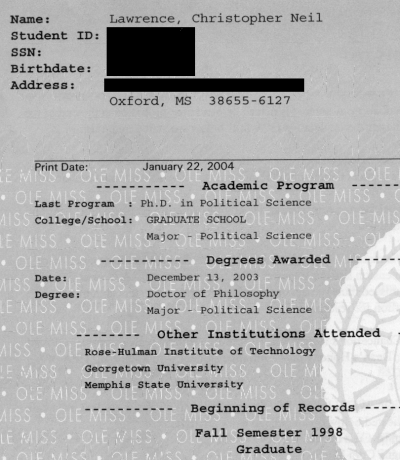
IMHO, $4/copy is a blatant ripoff for an official transcript, particularly when they’ll give you unofficial ones for 25¢ per page.

But at least I now have some proof I actually accomplished something the last five-and-a-half years: