Tuesday, 18 November 2003

Shake it on down

Jeff Taylor and Joy have the latest on our friends at the Santa Cruz Operation; Jeff* characterizes SCO’s business model as “consist[ing] of filing suit against Linux users.” I think he’s being charitable; it’s more like “trying to sell for $200/seat technology written two decades ago by a bunch of kids at Berkeley that’s today worth about 10 cents.”

You know, in 1999 or so, that could have been the basis for a decent IPO. Hell, nobody else back then had a viable business model either…

Arrow's Impossibility Theorem and IIA

Steve Verdon explains Arrow’s Impossibility Theorem, one of the most important theorems of economics and “rat choice” political science. Unfortunately, he doesn’t explain one of the key assumptions—the independence of irrelevant alternatives or IIA assumption—in much detail, which is a shame because I’ve never found a good explanation of it that doesn’t talk about the colors of buses. (It’s often called the “red bus, blue bus” problem for that very reason—that’s the classic example used to explain IIA, which leads most people to correctly ask, “but what if my problem has nothing to do with buses?”) Despite that (very insignificant) shortcoming, it’s an interesting post.

Privatizing marriage

Following today’s Massachusetts Supreme Court decision in Goodridge v. Department of Public Health, there’s been some predictable noise in the libertarian blogosphere in favor of “privatizing marriage“. Normally, I’m pretty sympathetc toward libertarian utopianism, but I’d like to throw a bit of cold water on this idea.

As Michael Kinsley observes in this pro-privatization article, government sanctions of marriage serves as a “bright-line rule” in legal and employment matters. It generates the right answer in the vast majority of cases, while minimizing economically inefficient negotiations.

If I decide to get a new job, I can ask one simple question regarding benefits: Do you offer health insurance for the spouses of employees? If they say no, I can walk out of the interview right then, since this is a benefit I will not negotiate away. And the employer is free to say “yes” without prying into my spouse’s medical history, because it knows that I’m not just trying to get insurance for some relative or casual friend who has a medical problem. (That is, government sanctioned marriage staves off the problem of adverse selection for the health insurance market.)

If I die from an aortic dissection tomorrow, there will be no costly legal wrangling over who inherits my vast fortune. My wife will. This is exactly what I want, as do most married people. And I didn’t have to hire an attorney to draft a will.

In other words, a universally recognized standard for who is “married” is economically efficient.

Now maybe the question of employer-subsidized health benefits could be solved by an oligopoly of private marriage companies. But the legal questions cannot be. The legislature will have to decide which marriage companies to recognize as legitimate, and then we’re right back to government-sanctioned marriage. Homophobic bigots will try to pass laws saying that their state, or the federal government, will not recognize any marriage sanctioned by a company that sanctions marriages between two individuals of the same sex.

In short, privatizing marriage is not going to work unless we privatize the rule of law itself.

And even if I’m wrong here, and privatized marriage might work in theory, it’s never going to happen. What are you going to tell the millions of couples who are already married? “Sorry, you’ve got to go pay $75 to a company to have your marriage recognized by your employer and by courts of law. And since we don’t know how this business is going to pan out, you should register with all three of the major marriage companies, until the natural monopoly kicks in and picks a winner.” Sorry, libertarians, but you’ll have a much easier time abolishing Social Security and Medicare.

So here’s my challenge to the libertarian proponents of privatized marriage. As Will Baude so eloquently put it, you’re in a second-best world. The lines have been drawn in this particular battle of the culture war, and you didn’t get to draw them. But you have to pick a side.

Will you be with the bigots, or against them?

Update: Lower taxes? What are you talking about, Chris? I'm pretty sure that the marriage penalty is one aspect of marriage that gays are not clambering for.

Gay marriage's latest

I won’t try to round up all of the posts on Massachussetts’ decision today (a sampler: Glenn Reynolds, Andrew Sullivan, Virginia Postrel, One Fine Jay, and James Joyner), but I think Brett Cashman’s post is about the most sensible I’ve seen, in terms of the whole “what happens next” question. However, I can’t see conservatives’ innate desire to use the state as a vehicle for social engineering waning as Cashman (rightly) suggests it should.

Instead, realistically I think we could see a draconian form of the Defense of Marriage Act Federal Marriage Amendment sooner rather than later, because the Democrats in Washington are far too spineless to oppose it, and I reckon you could round up 38 state legislatures—bodies full of people looking for ways to avoid giving voters a good reason to vote them out—to ratify the thing in a big hurry. The bottom line is that conservatives aren’t going to let Roe happen twice, because exactly what Matt Stinson predicted here is just around the corner.

Matthew Stinson has a must-read new post on the topic as well. I think many social moderates would share his viewpoint, expressed here:

For what it's worth, I would be more inclined to support gay marriage nationally (rather than locally) if I believed gays desired marriage for more than just its economic and legal benefits. Yes, one's sense of dignity is benefited by having the right to marry, but what's lost on many gay marriage advocates is that marriage is about fidelity as much as it is sharing resources. Andrew Sullivan, to his credit, has argued that the option of marriage will have a civilizing effect on gay men. But gay men aren't children, and they can choose fidelity now if they want. That the vast majority do not do so suggests to me that gay male marriages, but not necessarily lesbian marriages, will be open marriages.

I’m personally not a big fan of outcome-based arguments for (or against) gay marriage, but this is an argument that will resonate with many fence-sitters. The more it sounds like gay people want marriage for the “free stuff,” like lower taxes* and cheaper healthcare, the more people are going to be turned off by it.

(Nor do I really buy the “civilizing effects” argument articulated by Sullivan; I suspect the number of straight men who’ve actually said, “I’d cheat on my wife with Lulu from the temp pool, but I can’t since I’m married” is within ε of zero. They might say “I’d cheat…, but I can’t since I’m in a committed monogomous relationship,” but you can have one of those without being married. It’s a function of character, not institutions.)

Also, you may enjoy this non-work safe post by Mr. Green, which refers to perennial SN foil Ricky Santorum. (Link via the Wizbang! post trackbacked below.)

Wallet-check time

Glenn Reynolds has the latest from our friends at the International Society of Political Psychology. He notes this email received from the group’s president by anti-left gadfly John Ray. Both are probably correct that no scholar with a right-wing bias would have written such an email; however, I’d attribute it more to a failed attempt at humor than to ideology per se.

I will note two empirical datapoints: my dissertation, which straddles the boundary of political psychology and mass political behavior, doesn’t have a single citation to a piece that appeared in Political Psychology, the society’s journal, despite citing nearly 250 distinct works—by comparison, the similarly obscure journal Political Behavior, which has significant overlap in scope, received 8 citations. A colleague, whose dissertation was even more explicitly in the political psychology tradition, also had zero citations of Political Psychology.* Since most people who join groups like the ISPP do it to receive the journal, if the society can’t publish a single journal article that would be even tangentially relevant to our dissertation topics (which, basically, is the criterion for a citation), it speaks volumes about the relevance of the ISPP to research in the subfield.

* There is a possible source of bias here: the University of Mississippi library doesn’t subscribe to Political Psychology—which may also speak volumes about the relevance of the journal to the subfield…

Database upgrade

The PostgreSQL database that runs Signifying Nothing behind-the-scenes was just upgraded (from 7.3.4 to 7.4). Hopefully the dump-and-restore step went smoothly, and none of the old content should have vanished into thin air.

Allegedly this release of PostgreSQL is faster, although how much improvement will filter through all the junk between your browser and the database (namely the LSblog code, which is hardly a model of efficient coding) is something of an open question.

Monday, 17 November 2003

What I'd do to the BCS

As it’s Monday, it’s time for the weekly howls of outrage to erupt at the latest BCS standings. Unfortunately for fans of college football, however, the outrage is largely manufactured and misplaced. Why?

  • Controversy sells. Getting people to watch the 6 EST SportsCenter is pulling teeth; hence why ESPN has pulled Dan Patrick back into full-time duty in Bristol, and why the BCS standings are a prominent part of the Monday show—to the point that they receive nearly 48 hours of pre-hype from “College GameDay Final” on.
  • The controversy is manufactured by the entities that have the most to lose from an independent evaluation of college football: the media. 65 of America’s leading college football writers and broadcasters have a vested interest in their ratings being the sole indicators of quality in college football. The regional and other biases of both the writers and the coaches are notorious. Nothing like some diversionary controversy to deflect attention away from the gorilla sitting in the corner.

There are legitimate reasons to critique the BCS standings. The fundamental problem is that they’re an ad hoc amalgamation of polls, an arbitrary selection of computer rankings, and fudge factors, necessitated by the false legitimacy that the Associated Press and ESPN/USA Today polls have among college football fans. From an econometric standpoint, there are serious problems with the BCS.

A fundamental problem is that truly ordinal data is treated as metric in the formula. Your age, height, and weight are metric data: differences in age have real meaning. If I’m 27 and my cousin is 3, the difference in our ages—24 years—is a meaningful quantity. By contrast, poll rankings aren’t metric. LSU is #3 in the AP poll, and Ole Miss is #15. 15-3=12. Twelve doesn’t tell us much of anything about the difference between LSU and Ole Miss; it just tells us that there’s a difference. Missouri is #27. 27-15=12. Treating this difference as metric makes an invalid assertion: that the difference in quality between LSU and Ole Miss is the same as the difference between Ole Miss and Missouri.

This problem repeats itself throughout the BCS formula. Means of rankings in polls and computer rankings are taken. These means are added together. The strength of schedule component—which is a key component of many computer rankings—starts as metric data, then is converted to a ranking and arbitrarily scaled… then added to the means. Losses—which are metric—are then subtracted. Finally, an ad hoc adjustment is made for so-called “quality wins”—an adjustment one would hope that is incorporated in the polls and computer rankings anyway. Then the rankings are reported with these bizarre totals attached, apparently because totals look cool (I guess they got the idea from the AP and ESPN polls, who report the sorta-kinda metric Borda count in addition to the rankings).

Nonetheless, the fundamental idea of the BCS rankings is sound, even if there are too many compromises and too many ad hoc adjustments. So what would I do?

  • Include more computer rankings.
  • Use averaging methods appropriate for ordinal data. Or at least, recognize that taking the mean of a bunch of ordinal data doesn’t make it metric… so make it properly ordinal again.
  • Eliminate the silly restriction that computer rankings cannot incorporate margin-of-victory as a factor in their formulas. (I’ll explain why this restriction is silly in another post.)
  • Eliminate the ad hoc adjustments.

Next time (which I intended to be this time—sigh), I’ll talk about “computer rankings” in more detail. It turns out that they can be thought of as an application of the oft-maligned statistical technique known as factor analysis.

D(efense)-Day

Mark your calendars… December 2nd is the day, at a secure, undisclosed combined conference room/classroom somewhere in Deupree Hall on the University of Mississippi campus. Of course, that’s not exactly the end of the tunnel, but pretty darn close.

Radical Interpretation of Matthew Yglesias

Up until today, if I had been asked to name the blogger that I most agree with (not necessarily my favorite blogger), it would have been Matthew Yglesias. This shouldn’t be surprising: we both have a background in analytic philosophy, both fans of David Lewis, we’re both consequentialists, we’re both liberals, and we’re both proponents of free trade.

But today he’s said something so outrageously false that, like Donald Davidson’s hypothetical man who says “There is a hippopotamus in the refrigerator” (from "On Saying That"), I have to wonder whether I’ve misinterpreted him.

Blogging about this list of the top ten albums of all time from Rolling Stone magazine, Matthew writes:

I would suggest that if you come to the conclusion that The Beatles are responsible for four of the top ten albums of all time, then your methodology is probably a bit off (they’re not, after all, the best band by whole orders of magnitude).

At first glance, he would seem to be saying here that not only are the Beatles not the best band of all time, they’re not even in the top ten.

But since this is self-evidently false, I must excercise Davidson’s "principle of charity". Like Davidson’s man who says “Look at that hansome yawl” while pointing at a ketch ("On the Very Idea of a Conceptual Scheme"), I must conclude that Matthew uses the term “Beatles” to refer to some group other than John, Paul, George, and Ringo. Perhaps he’s confusing them with the Monkees.

I must, however, agree with Matthew that Rolling Stone’s methodology must be a bit off. Not for the reason that he cites, but because Abbey Road is not one the four Beatles albums they put in the top ten.

Update: Brian Weatherson, resident philosopher at Crooked Timber, weighs in with his top ten list. His methodogy is a bit off too, since he also leaves out Abbey Road.

Broker THIS!

Steven Taylor throws cold water on the idea that the Democrats will have a so-called “brokered convention”—i.e. that the plurality winner of the primary process won’t be the ultimate nominee. This isn’t the 1960s, and the Democratic base—particularly the Deanites—isn’t going to accept such meddling from party elites, and no amount of wishful thinking from either the media or anti-Dean forces in the party is going to affect that.

To get someone—anyone—other than Howard Dean as the nominee is going to require a lot of anti-Dean Democrats to swallow their pride and put the party ahead of their own interests before the end of the year (maybe even the end of November), so the designated “anti-Dean” candidate—Dick Gephardt seems like the only alternative with enough Old Left street cred, regional ties in the midwest swing states, and establishment support—can gain sufficient traction against both Dean and the novelty candidates. And if you see John Kerry, John Edwards, or Wes Clark stepping aside to back Gephardt, you’re truly kidding yourself.

My current theory on how the nomination battle will play out is explicated here.

James Joyner essentially agrees.

Sunday, 16 November 2003

Tariffs

Both Matt Stinson and Robert Garcia Tagorda note George Will’s Sunday WaPo column on the politics of the steel tariffs—and of the European Union response to them. Like Robert, I hope this development gives the administration the final push it needs to abandon the tariffs, before this escalates to a trade war which neither the U.S. nor foreign states can win.

Saturday, 15 November 2003

Quickie SEC football thoughts (Nov. 15)

My first losing record—heck, my first loss—on these picks was last Saturday. But, instead of quitting while I’m ahead, here are some more picks:

  • TENNESSEE over Mississippi State (JP split). “Duh” pick of the week.
  • Florida over SOUTH CAROLINA (JP split). Florida just has too much talent for the Gamecocks to handle.
  • ARKANSAS over New Mexico State. A bit late for an out-of-conference game, n‘est-ce que pas?
  • VANDERBILT over Kentucky. Coin-flip.
  • GEORGIA over Auburn. Yes, Auburn’s won five straight in Athens, but it won’t be six, even against a depleted Georgia team.
  • Louisiana State over ALABAMA. Some peoples’ upset special; I do expect a fairly close game for a while, but ultimately LSU is a superior team to the Crimson Tide.

The Rebels have a week off to prepare for the biggest football game ever from Oxford, one week from today at 2:30 pm on CBS.

Friday, 14 November 2003

Deanfest hits Oxford

The local Deanies are congregating tonight in Oxford, according to today’s Daily Mississippian. I pass this along in case you want a warning notice to flee across state lines lest you come into contact with any of these individuals.

Incidentally, the fact that one of Dean’s aides is named—and I truly wish I was kidding—“Zephyr Teachout” will explain everything you need to know about this presidential campaign.

Thursday, 13 November 2003

Good news, everyone

According to Professor John Folts at the University of Wisconsin, Guinness beer reduces the risk of blood clots that cause heart attacks. Apparently, though, this effect is confined to darker beers. Heineken did not have the same effect.

I for one will have no trouble incoporating this new medical breakthrough into my daily health regimen.

I would, however, like to correct one piece of misinformation in the Independent's article:

Light-coloured beers, such as lagers, lacked the same health-giving punch.

There are many dark lagers, such as the delicious Dixie Blackened Voodoo Lager, which I unfortunately cannot seem to find in Memphis anymore.

Godfrey’s latest

One of the few good reasons to pick up the Daily Mississippian this year, if you don’t happen to have a pet bird, is that it often contains Steven Godfrey’s “The Tight End” column. This week’s edition fails to disappoint, with riffs on Miami ’roid-rager Kellen Winslow, “SEC on CBS” sideline reporter Jill Arrington, and ESPN2’s insipid “Cold Pizza” morning show. Money quote on Winslow:

Kellen also let out the big secret about us writers: We make a ton of money from football player quotes. Why, just the other day when I was counting quarters for gas and realized I was short, I just used football player quotes in trade.

It’s better than foldin’ money.

For more on Kellen’s latest troubles, see the Big East Fanblog.

Dipshits comment at Daily Kos; news at 11

Amanda Butler and Will Baude note some idiocy going on in the comments at The Daily Kos. In fairness to Kos, it looks like the message in question is a comment and not an actual post made by a bona fide Kos article poster, so it’s hard for me to get too upset about it (except to repeat my regular complaint about blog comment sections in general).

That being said, both Amanda and Will have excellent rebuttals to this full-fledged display of ignorance. I won’t pretend that Mississippi doesn’t have its quota of bigots—I’ve had the dubious pleasure of teaching at least a couple of them—but I don’t think I’ve been anywhere in America, “southern” or not, that lacked a few unreconstructed racists running around.

Links via Pejmanesque.

Wednesday, 12 November 2003

The far left versus Sorority Row

Matthew Stinson, a fellow member of the patriarchy who is similarly burdended with false consciousness, has an entertaining and informative post about on-campus politics at FSU. For some odd reason, far-left identity politics hasn’t gained much of a foothold here at Ole Miss, so it’s nice to see that it’s alive and well elsewhere in the South.

That silly marriage amendment again

It seems that discussion of the proposed “Defense of Marriage” amendment makes Andrew Sullivan take leave of his senses. He spends a lot of time ranting about “celibacy,” a term that appears nowhere in the amendment’s text. Here’s the text, as presented by Sullivan:

Marriage in the United States shall consist only of the union of a man and a woman. Neither this constitution or the constitution of any state, nor state or federal law, shall be construed to require that marital status or the legal incidents thereof be conferred upon unmarried couples or groups. Neither the federal government nor any state shall predicate benefits, privileges, rights, or immunities on the existence, recognition, or presumption of sexual conduct or relationships.

Now, let’s deconstruct that paragraph. Sentence one is plain English, so that’s easy. Let’s take a looksee at #2:

Neither this constitution or the constitution of any state, nor state or federal law, shall be construed to require that marital status or the legal incidents thereof be conferred upon unmarried couples or groups. [emphasis mine]

Note the “shall” clause. This, in a nutshell, means that anything that doesn’t explicitly say “gay people may marry each other” cannot be construed to mean, well, “gay people may marry each other.” Sounds simple enough. Now onto #3:

Neither the federal government nor any state shall predicate benefits, privileges, rights, or immunities on the existence, recognition, or presumption of sexual conduct or relationships.

This is apparently where Sullivan goes off on his bizarro rant about celibacy. To put it crudely, this sentence—in English—means, “you aren’t entitled to anything just because you’re fucking someone else.” How on earth Sullivan makes the leap to this sentence creating the precedent for some sort of “don’t ask, don’t tell” police force just boggles the mind; if anything, it would seem to preclude it, because having a sexual relationship cannot have any effect on your “benefits, privileges, rights, or immunities.” This sentence says, whether Sully’s fucking his boyfriend or sleeping down the hall in the spare bedroom, it makes absolutely no difference.

Frankly, I agree that this amendment is fundamentally silly, although, unlike Sullivan, I’d rather have the state out of the business of marriage as completely as possible, leaving it to contract law and civil society—hence why he’s a conservative, while I’m a libertarian. And if Sullivan wants to marry his boyfriend, or the hypothetical lesbian commune down the street wants to organize a group marital arrangement, it’s nothing that’s going to cause the end of the universe; even if God cares, I suspect He has more important things to worry about. But I’d expect someone who, you know, writes for a living might actually be capable of reading what’s in front of his face. And, in this case, I think Sullivan’s dislike for the proposal has blinded him to what the actual text says.

And Sullivan’s still obsessing; apparently, what’s important to him aren’t the benefits of marriage; it’s the societal imprimateur that government recognition of gay marriage would convey. The conservative’s complete, and misguided, faith in government as a qualified social engineer emerges yet again.

Lawrence gets results from OTB, VodkaPundit

I don’t have a hokey website like perennial SN foil Larry Sabato, but I do make slightly better predictions than James Joyner and Stephen Green. Quoth James:

I always thought that the race was going to come down to electable candidates because of the dampening effects of the early Southern primaries. I figured Dean could do well in the “retail” contests in Iowa and New Hampshire—although perhaps losing both of them to favorite sons Gephardt and Kerry—by energizing the base. But I thought, and indeed continue to think, that he’s not going to be very appealing in South Carolina and the Super Tuesday states.

... With so many of the primaries stacked at the beginning of the year, fundraising is even more crucial than ever. Right now, the only candidates I can see able to sustain a serious race against Dean are Gephardt—who pretty much HAS to win Iowa or he moves up three shades on the Toast-O-Meter—and Wes Clark, who has a pretty good team thanks to the Clinton Machine. But I don’t know who Clark’s base is at this point and Lieberman’s presumed base, organized labor, seems to be split between him and Dean. So the key is to survive the early primaries and hope there’s an “anybody but Howard Dean” movement. [emphasis mine]

Fundraising, organization, and exciting the base are going to hand this nomination to Howard Dean, and I’ve been saying that to anyone who’d listen to my drunken political ramblings in bars and on rooftops since mid-July. The key to both Iowa and New Hampshire is getting the base on board the campaign, and that’s something that Dean has mastered.

The problem for the anti-Dean forces isn’t that Iowa and New Hampshire will lock the nomination up; instead, the problem is that the post-New Hampshire winnowing process doesn’t effectively winnow candidates—it’s far too time-compressed. Anyone who has enough money in the bank now to last until Iowa can survive until mid-March, on the basis of the money they’re going to get from today until Iowa alone. Fundraising simply won’t dry up fast enough to stop candidates who lose in South Carolina from persisting through Super Tuesday and beyond.

The other problem for the serious anti-Dean candidates is that the weighted PR system adopted by the party for this round—you qualify for delegates if you get 15% of the vote in any congressional district—benefits candidates who can draw clear distinctions between themselves and the other candidates. There’s no clear substitute for Dean in the field. On the other hand, Kerry is essentially interchangeable with half-a-dozen other white guys in suits in the field; the “I like an establishment Democrat” voter has no clear favorite, so they’ll just spread their votes around four or five different ways. The other likely beneficiary from the allocation rules is Al Sharpton, who will get a lot of his delegates from states that are unwinnable by the Democrats in the general election—particularly since the delegates aren’t allocated equally by congressional district, instead extra delegates are allocated to congressional districts that vote for Democratic presidential candidates.

Unless most of the “establishment Democrats” like Clark, Kerry, Gephardt, and Edwards can come to an agreement—and soon—that essentially has everyone except one of them drop out to maximize the “anybody but Howard Dean” vote, I don’t see any way for anyone but Dean to capture an overwhelming majority of the elected delegates. And even if Dean fails to capture an outright majority (including the superdelegates), I find it exceptionally unlikely that the Democrats would be able to get away with brokering the convention to nominate either a “white knight” candidate or a candidate who lost head-to-head with Dean in the primary process—frankly, I think the Dean base would abandon the party if it came to that. So, for now, it’s essentially Dean’s nomination to lose.

And Matthew Stinson points out the second half of the Dean Catch-22: his complete and utter unelectability.

Trade and jobs

Daniel Drezner is displeased at the news that the administration may try to evade the WTO ruling against the steel tariffs. The adminstration plans to maintain these protectionist barriers despite evidence that the steel tariffs cost many more American jobs—in many industries that use steel—than they saved.

The open political question is whether the tariffs are causing enough damage to the overall economy, including the economic recovery, that their marginal benefit in states like West Virginia is offset. The trouble here is that the marginal benefit from the tariffs is easy to quantify, because it is concentrated, while the damage is diffuse—thousands of jobs spread across perhaps two dozen states. And that damage could get far worse if it leads to a trade war with the European Union, who—in this case, at least—are clearly in the right.

Like Dan, I hope the administration will come to its senses. But I can’t be optimistic, especially since the dynamics of the Democratic campaign preclude almost any criticism of Bush from that quarter for not being enough of a free trader.

Monday, 10 November 2003

Disliking the Compass

Colby Cosh vents his spleen over the latest blogospheric fad, the “Political Compass” test, while Jacob Levy finds it weird and potentially unreliable.

Sunday, 9 November 2003

Dean and the South

Matthew Stinson links to a Jonathan Chait TNR piece that takes Howard Dean to task for his vague Southern strategy. As Chait points out, it’s Southern Politics 101 all over again:

So Dean’s plan is to get poor Southern whites to vote their economic interests rather than their cultural predilections. How simple! Why hasn’t somebody else thought of that idea? Oh wait, that’s right: Everybody has thought of that idea.

The notion that the Southern economic elite try to divide the populace along racial rather than economic lines goes back around 400 years. Even though most southern whites didn’t own slaves, a majority of them supported the institution. ...

As it turns out, forging that economic coalition is a good deal more difficult than it sounds. The only success liberals have enjoyed has come when they’ve found candidates like Bill Clinton, who distanced himself from cultural liberalism (on issues like crime and welfare, for instance) to convince Southern whites that he was more conservative than the national Democratic Party.

Actually, before the 1960s maybe-realignment, southern Democrats regularly ran on economic issues—and won. The most infamous example is Huey Long, but national Democrats running for the presidency were winning electoral college votes across the South into the 1960s. What’s changed?

  1. Since the Great Society programs of LBJ, and their consolidation under Nixon, there’s a sufficient national “safety net” that Republicans are not going to dismantle—no matter what rhetoric you hear from the far left. This has diminished the economic interest of poor whites in supporting Democratic candidates.
  2. The national Democratic party has moved away from the conservative values shared by southern whites, most infamously in its blanket support for Roe v. Wade. This makes Republicans relatively more appealing.

Can national Democrats recapture the South? Unless they can neutralize Republicans’ natural advantage on “race, guns, God and gays,” or can come up with an economic program that is overwhelmingly appealing to both poor whites and blacks (perhaps like Dean’s idea of “affirmitive action” on the basis of economic status, rather than race), that seems exceedingly unlikely.

Saturday, 8 November 2003

Hell yeah, damn right

Ole Miss 24–Auburn 20. I’ve just got one thing to say:

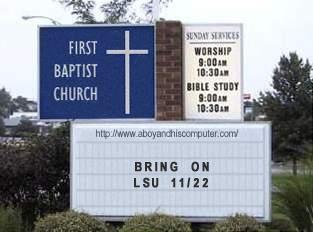
Bring on LSU 11/22

WLM?

Is it just me, or are these sorts of editorials only written when Republicans win elections?

Stupidity 202—and I approve this post!

Steven Taylor points out yet another idiotic provision of the Bipartisan Campaign Reform Act—just in case all of the other idiotic provisions of the Incumbency Protection Act of 2002 were insufficient to raise your ire.